
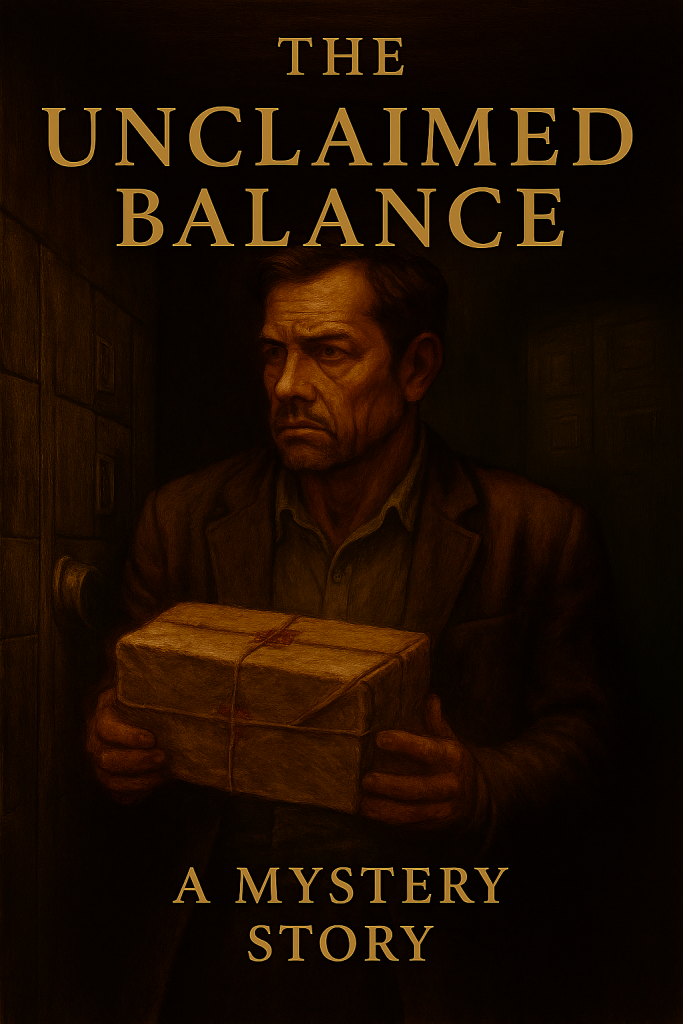
Bristol archivist Manny Thorne is facing a financial crisis as he prepares for his daughter’s future. His loyalty is tested when he finds a valuable relic with no discernible owner, forcing him to confront a profound test of character in The Unclaimed Balance.
The Unclaimed Balance

The Discovery in the Dust
Manny Thorne, forty-two and meticulous to a fault, pulled a linen cloth from the last row of the high-security basement vault. His job as an archivist for the venerable firm of Kenworthy & Sons was a precise, quiet calling. It usually involved nothing more dramatic than classifying probate records from the interwar period.
He was a man of routine, which suited his reflective nature. But routine offered little solace against the mounting reality of his daughter’s looming university tuition fees. The prospect felt like a physical weight on his chest, one he couldn’t shift. He and his wife had run the numbers a dozen times; they were still a significant sum short.
He was deep in the vault, a subterranean space smelling faintly of dry rot and aged paper. His directive from Mr. Finch, the new, aggressively modern director, was to perform a brutal inventory to identify “redundant assets.” Manny loathed the term.
It was while checking a long-neglected sub-section that he found it: a fragile, sealed, 19th-century deposit box tucked behind a stack of old ledgers, its brass fixtures tarnished black. It was entirely unlisted.
He carefully prised the seal with the tip of his knife, his heart giving a small, unwelcome jump. Inside, protected by silk, was a single, immaculately preserved document, a bearer bond, redeemable by the holder for the sum of fifty thousand pounds. The firm’s name was on it, but the document was centuries old, effectively anonymous.
The Unclaimed Balance was a reality.
The Weight of the Ledger
The bond, neatly folded and now sitting inside a plain manila envelope in Manny’s filing cabinet, was an oppressive presence. It represented a simple solution to a desperate problem. Fifty thousand pounds would not only cover the tuition fees but allow his daughter to leave Bristol and attend the prestigious London university she had set her heart on. It felt like providence; a cosmic oversight placed squarely in his lap.
Manny spent the next three days poring over the firm’s surviving nineteenth-century ledgers, his movements slow and deliberate, the dry heat of the vault doing nothing to cool the debate raging within. He checked every account, every transaction log, and every register of assets until his vision blurred and the spidery copperplate script seemed to dance on the aged pages. The bond did not exist in any record. It was a ghost, a financial echo from a past owner who had almost certainly vanished without a trace.
The pressure from Mr. Finch did not help. Finch was a man who valued expediency over history. “Find anything you can liquidate, Thorne,” Finch had chirped, leaning over Manny’s desk with a smile that never quite reached his eyes. “We need capital, and we need it now.”
Finch had no idea of the value Manny was sitting on, yet his directive served as an unnerving external justification: the firm needed the money. Manny could simply present the bond as an “unlisted asset,” quietly cash it, claim a finder’s fee, and no one would ever know the difference. The internal flaw, his desperate need to prove he could secure his daughter’s future, screamed at him to take the easy route.
A Forged Entry, Unwritten
Manny pictured his daughter’s delighted face, free of the worry of student loans, and he almost yielded. He pulled the bond out, the thin paper crisp and startlingly heavy in his hands, and mentally wrote the forged ledger entry. He could almost feel the nib of his pen scratching the false history into existence.
But that was the rub. Kenworthy & Sons was built on Trustworthiness, the principle of fulfilling a trust, sometimes generations after the trust had been established. Manny was the custodian of this trust, even if the current management had forgotten its meaning. To claim the bond was not merely theft from the firm, which was already on shaky financial ground, but a violation of the trust placed in him by the long-dead original owner, whose intent was unknown. The thought felt like grit between his teeth.
The Truth in the Binding
In the dead of night, he returned to the vault. He needed to find the truth, not just a justification for theft. The single bare bulb cast long, dancing shadows as he worked, the silence of the basement a profound presence.
After hours of searching, he found a tiny, handwritten note slipped into the binding of the heavy, leather-bound ‘Client Register: 1870.’ The note, dated 1872, described the bond. It wasn’t an investment; it was an emergency fund, held in trust for “The Grandchildren of T. A. C.” The note concluded, chillingly, “This must never be touched unless the claim is verifiable.”
The money belonged to an unknown family line, held under a fiduciary duty that stretched across two centuries. The moral test reached its climax.
Manny took a deep, shuddering breath of the dusty air. He carefully wrote a full report, citing the newly discovered note, and detailing the full history of The Unclaimed Balance. He returned the bond to its box, sealed the box with new tape, and placed the entire report on top of the envelope.
Simple Rectitude
The next morning, Manny walked into Mr. Finch’s office, the report feeling heavier than the bond itself. He explained the discovery, the value, and the corresponding fiduciary note. He noted Finch’s face cycling through greed, confusion, and finally, disappointment.
“Thorne, are you telling me you’ve found fifty thousand pounds and handed us a centuries-old headache instead of a profit?” Finch demanded, his voice tight.
Manny simply replied, “I found an unfulfilled trust, sir. Our duty is to fulfil it.”
Finch, bound by the legal and historical record now in his hand, had no choice but to initiate the process of locating the descendants of T. A. C.
Manny received no bonus, no finder’s fee, and his daughter’s tuition still lacked a solid solution. The reality was difficult; he would have to take out a high-interest loan.
Yet, as he settled back into his work cataloguing unremarkable documents, the familiar weight on his chest was gone. It had been replaced by a simple, quiet rectitude.
He had guarded the trust, and in doing so, he had secured his own integrity, a more valuable asset than any bearer bond.
He looked forward to telling his wife and daughter, not about the money he almost had, but about the principle he kept.
About The Story
The Unclaimed Balance explores the principle of Trustworthiness (Fulfilling a Trust). Manny, faced with a profound financial temptation, must decide whether to betray a centuries-old fiduciary duty for his immediate personal gain.
The narrative shows that true trustworthiness is not merely about honesty when observed, but about maintaining integrity and fulfilling one’s obligations, even when secrecy is guaranteed and the consequences of moral failure are only internal.
Enjoyed This Story?
If you enjoyed this story, explore our website’s diverse collection of short stories. We offer thrilling adventures, heartfelt romances, gripping thrillers, compelling biographies, captivating science fiction, fantasy, chilling horror, meticulously crafted historical fiction, and thought-provoking literary fiction. Each story is chosen to entertain, transport, ignite imagination, and spark curiosity. Find your next favourite read and embark on an unforgettable journey.
Stay connected — laughter and love are only a story away.